
Introducing the Arrangement for Transitional Constitution (AFTA)
As the Spring Revolution has championed "ending military dictatorship and building a federal democratic union", discussions on the constitution have been taking place since February 2021. Revolutionary forces have rejected and opposed the 2008 Constitution, controversially adopted under military dictatorship, and revolutionary organizations have declared it void. During the revolution, Parts 1 and 2 of the Federal Democracy Charter have been issued and used as a constitutional framework. The roadmap set out in the charter also includes, as one of its stages, drafting a constitution for the post-revolutionary transition period during the revolution itself.
How It Emerged
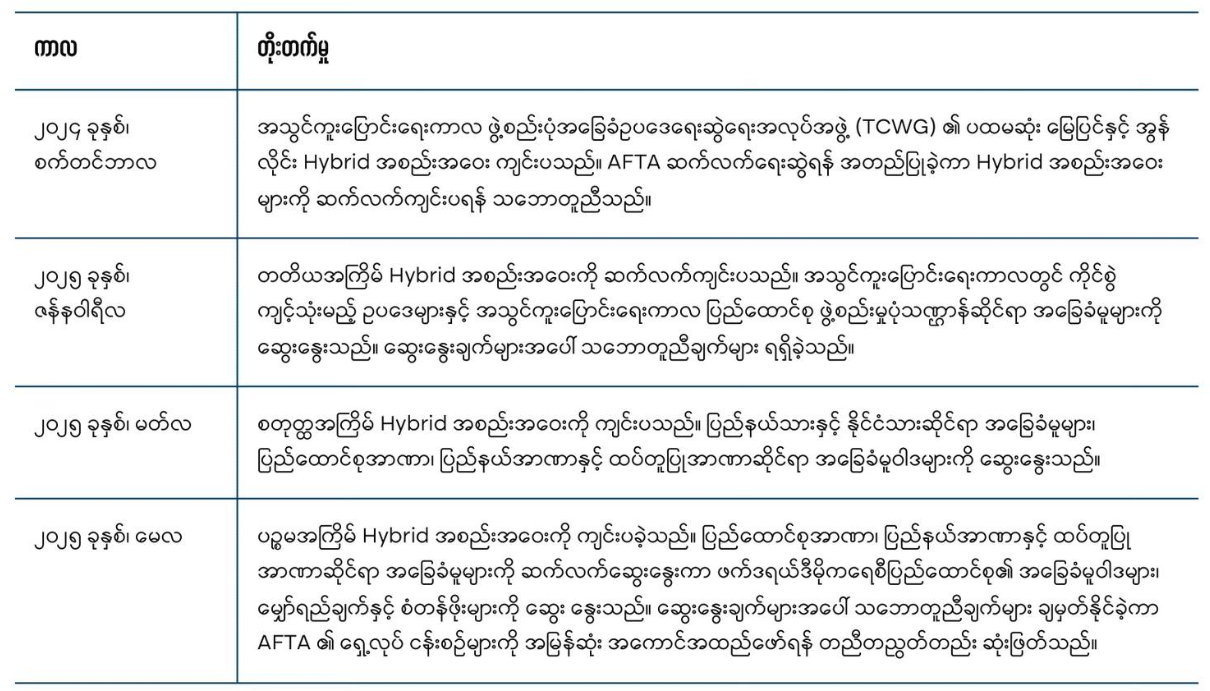
The National Unity Consultative Council (NUCC) formed the Transitional Constitution Working Group (TCWG) on July 11, 2022. The National League for Democracy (NLD) and the Kachin Political Interim Coordination Team (KPICT) were part of the working group when it was formed, but the NLD later stopped participating. After its formation, the working group did not publicize its work, but in May 2025 the NUCC announced that in-person and online meetings had been held since September 2024. Through that statement, it officially announced the start of drafting the Arrangement for Transitional Constitution (AFTA).
The Common Position of Groups Jointly Fighting to End Military Dictatorship and Build a Federal Democratic Union
To trace the shift from a transitional constitution to AFTA, it is necessary to revisit the common position issued on January 31, 2024, by the "groups jointly fighting to end military dictatorship and build a federal democratic union". The organizations that issued the position are the Chin National Front (CNF), the Karenni National Progressive Party (KNPP), the Karen National Union (KNU) and the National Unity Government of Myanmar (NUG).
The statement includes six goals: ending the Myanmar military's involvement in politics; placing armed forces under civilian government; completely abolishing the 2008 Constitution and fighting any attempt to revive it; drafting and enacting a constitution based on a federal and democratic system accepted by all stakeholders, and building a new union through it; and achieving justice for those who suffered abuses during the conflict. The statement also includes drafting and enacting a transitional federal democratic constitution as a sub-process.
Bottom-Up Federalism
On February 12, 2025, the KNU, KNPP, CNF, the New Mon State Party (Anti-Dictatorship) (NMSP-AD), the Karenni State Consultative Council (KSCC), the Pa-O National Federal Council (PNFC), the Mon State Federal Council (MSFC), the Ta'ang Political Consultative Committee (TPCC) and the Women's League of Burma (WLB) issued a statement announcing that AFTA was being drafted.
In an interview with Burma News International (BNI) in February 2025, Nang Moe Moe, spokesperson for the nine ethnic resistance organizations and state/ethnic-based federal councils, said AFTA is a drafting process for the transitional period and a first step toward bottom-up federalism.
She explained that AFTA is only for the transitional period and will automatically become void once a federal union constitution is adopted, and that the federal constitution will be drafted based on it.
Negotiations are under way with other political and revolutionary organizations. AFTA is intended for the union level; while it differs from the constitutions being drafted by individual states, it will connect with them without contradiction. It has also been agreed to include provisions on human rights violations in AFTA for transitional justice, and the details are still being discussed.
The statement says they are steadfastly working toward a federal union made up of states with democracy, national equality and full self-determination; that they are working on additional endorsements of the common position, which contains six political goals, nine positions and six processes, and on broader participation; and that they will not accept a "holding together" federal system that would re-strengthen centralization, but will build the union in practice based on a "bottom-up federalism approach", strong states building a strong union.
The NUG's Involvement
The NUG, which is part of the Transitional Constitution Working Group (TCWG), discussed AFTA at its cabinet meeting 9/2025. Prime Minister Mahn Win Khaing Than urged that regions and federal units are working hard to establish governments, and that establishing administrative mechanisms is an urgent priority for the transitional period; that the federal transitional arrangement process being prepared by revolutionary leading groups must be pushed forward vigorously; and that, since it is important for the union and federal units to move in balance and in step, government officials should encourage the groups involved in the AFTA process.
The AFTA Drafting Process
On May 25, 2025, the National Unity Consultative Council (NUCC) issued a press release on the Transitional Constitution Working Group (TCWG) and the drafting of the Arrangement for Transitional Constitution (AFTA). The press release described the AFTA drafting process as follows.
How AFTA Will Be Adopted
In an article titled "Federal Transitional Arrangement Picks Up Pace", published on July 5, 2025, Myanmar Now reported that once AFTA is approved by the National Unity Consultative Council (NUCC), a Pre-Federal Conference will be held in which all current political groups will take part, and those who have not yet been able to join for various reasons will also be invited.
It reported that the political, military and federal unit arrangement agreements emerging from the conference will be approved by the federal conference, and that through the conference the NUG government will be reformed before the military council's sham election into a complete and stronger interim transitional government. The article also stated that the transitional government must then adopt and enact a constitution embodying federal democracy, the goal of the Spring Revolution, and transfer power to a democratically elected federal government and the relevant state governments. However, there has been no official announcement yet.
Conclusion
The AFTA process appears to have been revived in mid-2024 and has become a meeting point for the main mainstream revolutionary forces in 2025. It can also be said that mainstream forces hope to present it to the public and the international community both as a political path before the election the junta intends to hold and as a vision for future nation-building. The draft has not yet been released, and since a draft can only be strong if the public can take part in discussing it, how this will be done needs to be watched closely.
Related updates
A House Built on Sand – The Junta's Election Plan
Gerrymandering means grouping or spreading out areas of assured support so that the outcome a party needs can be shaped as desired. For the junta, it has already created conditions in which only its backed Union Solidarity and Development Party (USDP) and a few supporting parties can contest and win, having dissolved major parties such as the National League for Democracy (NLD) and the Shan Nationalities League for Democracy (SNLD) amid a broad political boycott. In that situation, it needs to create the appearance that the election can be held widely.
Mandalay Region Interim Political Arrangement
The "Mandalay Region Interim Political Arrangement" (draft) has been written with 12 chapters and will soon be adopted. The draft has been officially released so that revolutionary political forces across the country, including Mandalay revolutionary forces and the public, can review it and send suggestions, and it is being further revised based on the suggestions received. Chapters 1 to 3 of the draft cover objectives, values and basic principles, and Chapter 4 covers fundamental rights, entitlements and duties. Chapters 5 to 10 cover the structure of the Mandalay region and its legislative, executive and judicial branches, Chapter 11 covers amendment of the arrangement, and Chapter 12 contains general provisions.
ASEAN, the UN and International Engagement on Myanmar in October
October was a period when Myanmar's affairs were once again discussed on the world political stage, with the ASEAN Summit and the UN General Assembly. Below is a summary report of international developments on Myanmar during October.
NUG Deputy Minister of Human Rights Granted Leave from Duties
The NUG announced on March 7 that Khun Bedu Htan, one of the deputy ministers of the National Unity Government (NUG) Ministry of Human Rights, had been granted leave from his duties.