Mandalay Region Interim Political Arrangement
Political Developments in Bamar-Majority Regions (1)
Introduction
The "Mandalay Region Interim Political Arrangement" (draft) has been written with 12 chapters and will soon be adopted. The draft has been officially released so that revolutionary political forces across the country, including Mandalay revolutionary forces and the public, can review it and send suggestions, and it is being further revised based on the suggestions received.
Chapters 1 to 3 of the draft cover objectives, values and basic principles, and Chapter 4 covers fundamental rights, entitlements and duties.
Chapters 5 to 10 cover the structure of the Mandalay region and its legislative, executive and judicial branches, Chapter 11 covers amendment of the arrangement, and Chapter 12 contains general provisions.
Background to the Arrangement
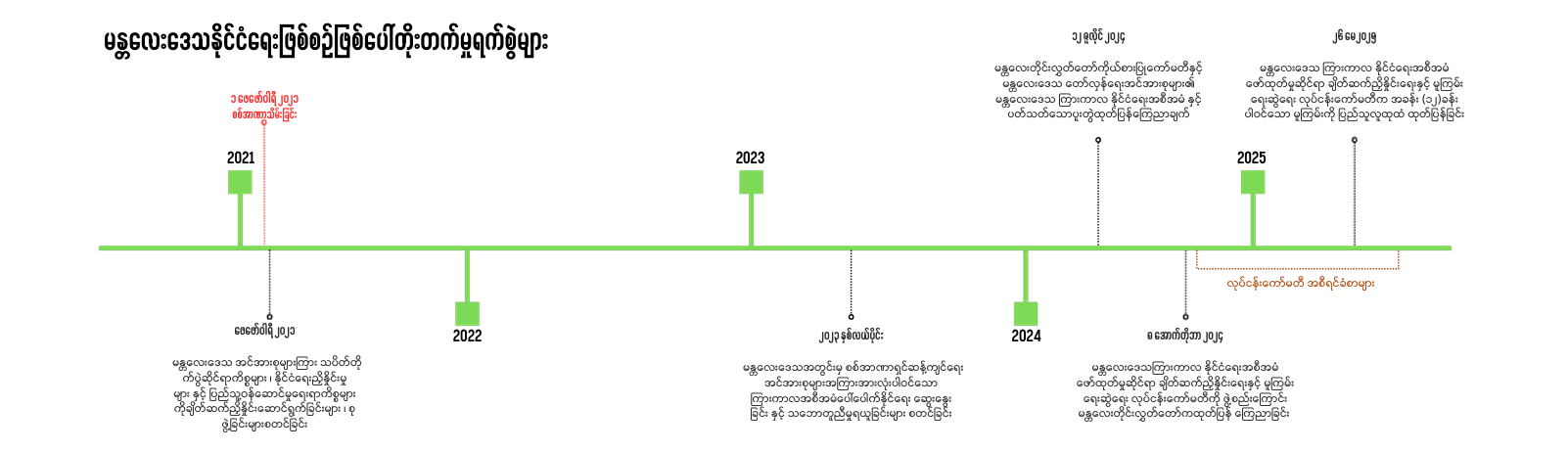
Discussions on developing an interim arrangement began in mid-2023, with the aim of creating a broader and more inclusive platform among Mandalay-based forces fully engaged in the Spring Revolution from every sector, and of supporting the process toward a swift and successful end to the revolution. The Federal Democracy Charter was used as the basis for discussing and drafting the principles and processes to be adopted.
Beginning in August 2023, after consultations among the Hluttaw, civil society, student unions, political parties, officials from revolutionary local administration, minorities, and those who should be included, the Committee Representing Mandalay Hluttaw (CRMH) and revolutionary forces reached agreement on July 12, 2024, on the "Work Plan for Developing, Coordinating and Drafting the Mandalay Region Interim Political Arrangement". To put this into practice, the "Working Committee for Coordination and Drafting of the Mandalay Region Interim Political Arrangement" was formed on August 8, 2024.
The working committee is made up of 40 representatives from six groups. These are: the group of Hluttaw representatives elected from the Mandalay region in the 2020 general election; the group of political parties taking part in the people's revolution; and the group of strike, CDM, union and civil society organizations. The strike/CDM/union group also covers workers, farmers, women, persons with disabilities, LGBTIQ people, and students and youth. The fourth group consists of officials from revolutionary local administration sectors, followed by the minority ethnic group and the group of those who should be included.
Representatives of the revolutionary local administration sector include the People's Administration Teams, People's Defence Teams and People's Security Teams under the National Unity Government (NUG). They were included mainly so that ground realities could be part of the discussion when drafting the arrangement. This group represents not only the armed People's Defence and People's Security Teams but also sectors such as humanitarian, legal, human rights and child affairs.
Nearly a year passed between the start of discussions on the arrangement and the formation of the committee, and many negotiations were needed to make the platform inclusive.
At present, only the National League for Democracy (NLD) and the Democratic Party for a New Society (DPNS) are in the party group. Under the threshold of 0.5 percent of the region's total population, the Shan are entitled to join the minority ethnic group but have not yet done so; only Kachin/Lisu representatives are currently included.
The Drafting Working Committee
Before the working committee was formed, the "Mandalay Region Meeting Point" (Man Taing Sone Sae Yar), which serves as a political platform for Mandalay revolutionary forces, began drafting a five-chapter "Work Plan". This grouping began early in the Spring Revolution to coordinate work among revolutionary forces.
The work plan set out the working committee's structure, processes and basic rules. After the CRMH confirmed that it would be formed with six groups, the "Working Committee for Coordination and Drafting of the Mandalay Region Interim Political Arrangement" was formed. Under the committee, three mechanisms operate: the "Coordination Sub-Committee", the "Drafting Working Committee" and the "Secretariat".
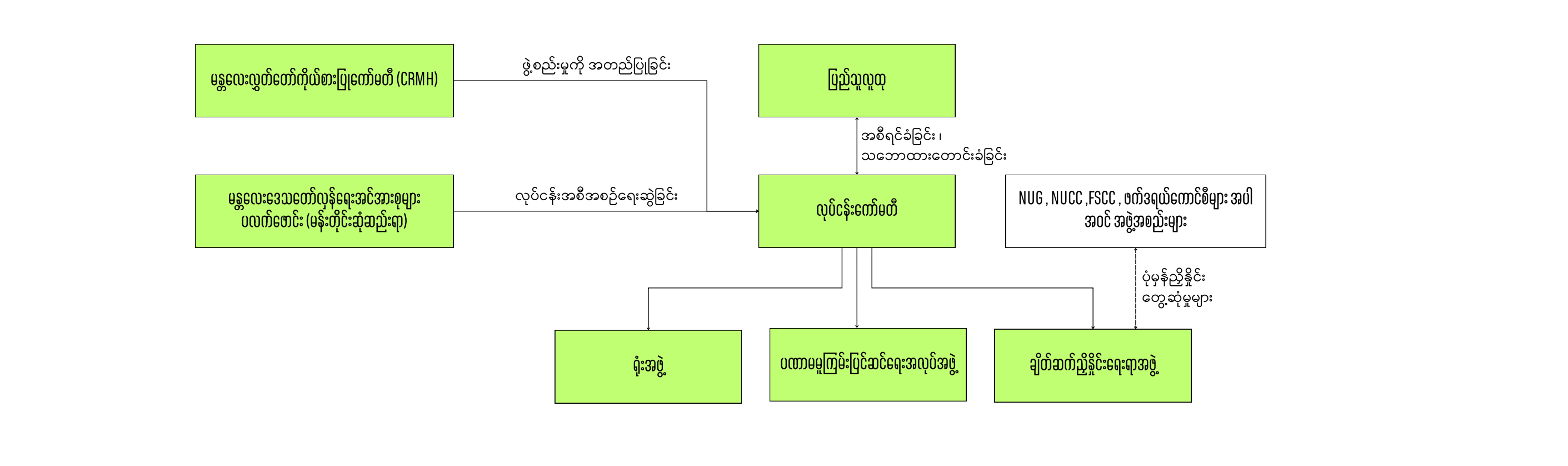
Within the drafting working committee, open discussions on what should and must be included in the arrangement came first, and only then did drafting begin. The working committee reported monthly to the Mandalay Region Meeting Point, the political platform of Mandalay revolutionary forces, and to the Hluttaw, and every two months to the public, releasing the draft chapter by chapter to gather suggestions. Meanwhile, the Coordination Sub-Committee met with the Federal and State Coordination Commission (FSCC) between the union government and states/federal units engaged in the revolution, the NUG, and 16 region-based federal units, councils and organizations, and reviewed and revised the draft.
Because some suggestions from these meetings are not yet suitable for the region or concern matters to be decided at the federal union level, a chapter on "Amendment of the Interim Political Arrangement" was included in the draft in advance so that such points can be revised.
Defining the Periods
The draft interim political arrangement is based on the Federal Democracy Charter (FDC) and defines the current period as the "interim period". It defines the period when the terrorist junta falls as the "transitional period" and the time of stability and peace as the "post-revolutionary period".
Seeking Public Opinion
The "Mandalay Region Meeting Point" is a platform-like grouping that has been organized since the mass strikes were strong in the Mandalay region after the coup. Although the strikes weakened after the terrorist junta crushed them with lethal force, participants in the Meeting Point continued to meet monthly online without interruption. These meetings mainly discussed military and political matters concerning the Mandalay region, and the discussions were shared through relevant networks and presented to the people of Mandalay.
After the drafting work plan was preliminarily approved at the "Mandalay Region Meeting Point", it was reported to the public that the CRMH had approved it through Hluttaw procedure. Once the drafting working committee was formed and working, its weekly processes and discussions were also shared with the public. At the same time, suggestions and discussion points from the public were gathered through online channels such as Telegram, Facebook, Signal and email, and used in the drafting process. Strike groups and civil society organizations also went to the field to explain the draft, and suggestions and points raised there were incorporated into the relevant chapters of the draft. Completed chapters were presented to the public as they were finished, and further suggestions and discussion points were incorporated into the draft.
Toward a Stronger Grouping: The Corridor
To strengthen coordination, the draft arrangement so far provides for forming a body under Chapter 5, the "Coordination Corridor of Mandalay Region People's Revolutionary Forces". The corridor is formed to support implementation of the interim arrangement's objectives and will include around 130 representatives from various revolutionary sectors, based on the existing Mandalay Region Meeting Point grouping.
The corridor has five functions: developing a political meeting point that encompasses all Mandalay region revolutionary forces based on collective leadership; preliminarily approving the draft arrangement; preliminarily approving amendments to the Mandalay Region Interim Political Arrangement as the revolution requires, in line with the arrangement's provisions; coordinating, advising and urging as necessary in the systematic implementation of revolutionary, legislative, executive and judicial work in the Mandalay region; and reviewing, critiquing, advising and urging on the reports and actions of the Mandalay region's three pillars, the legislative, executive and judicial bodies.
The corridor takes the form of a conference and is structured to steer horizontally between two extremes: dominating the three pillars that will emerge under the arrangement, and sidelining the revolutionary groups that emerged from the Spring Revolution.
The corridor will be formed with seven groups rather than the six groups of the drafting working committee. In addition to the committee's original six groups, a new group of "Mandalay Region Representatives Assigned by the Interim National Unity Government" will be added. The six existing groups mainly represent the Mandalay region; the new group was added on the reasoning that including the NUG government's views, as the link between the union and the federal unit once the three pillars emerge under the arrangement, will better support ground operations. It also aims to make work more effective, since some of the NUG's administrative and military mechanisms already extend to the township and district levels on the ground.
Promoting Women's Participation
The Mandalay Region Interim Political Arrangement sets gender equality and non-discrimination as values, and efforts are under way to put them into practice at every level of the structure.
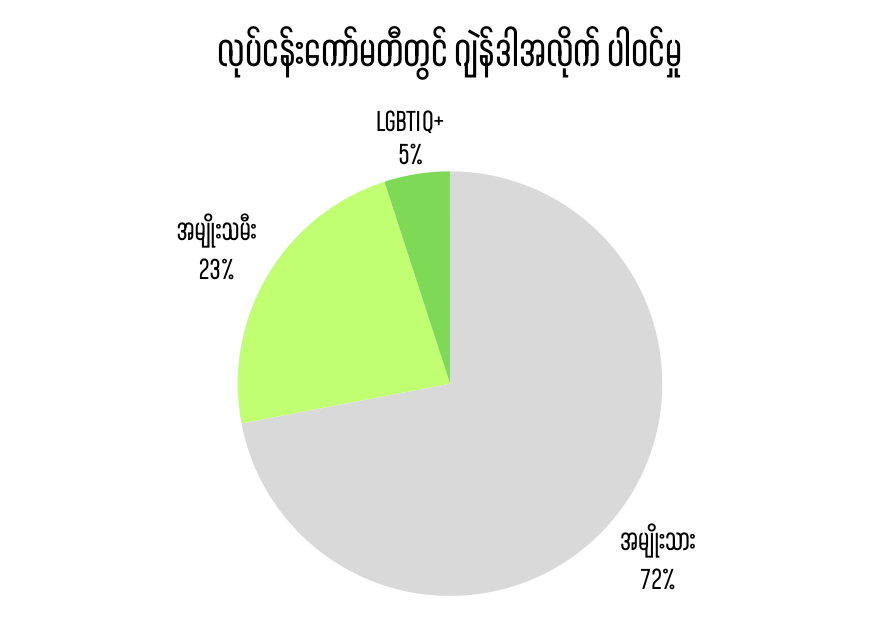
When the six-group working committee was formed, women made up 23 percent of its members, and 32 percent of the "local administration sector" group were women. However, achieving 30 percent women across all groups remains a challenge.
Mandalay Interim Governing Council (MIGC)
The draft arrangement provides that the "Mandalay Interim Governing Council" (MIGC) shall be formed with a minimum of nine and a maximum of 15 members, comprising a chair, vice-chair, secretary and members. To select council members, a "Council Member Selection and Vetting Team" of 11 to 15 members from the "corridor" must first be formed, and the arrangement states that the selection team must consist only of representatives sent by the six groups that existed when the working committee was first formed.
Within four weeks of its formation, the selection team must send the list of selected council members and their full biographies to the Mandalay Region Hluttaw, which must approve and form them as the "Mandalay Interim Governing Council (MIGC)". All MIGC members must actually reside and be able to serve in the Mandalay region and related revolutionary areas. The council chair may, by consensus within the council, assign suitable members as department heads.
The council must give weight to the recommendations reached in discussions at the "Coordination Corridor of Mandalay Region People's Revolutionary Forces" and carry out executive duties in line with the arrangement's provisions. The council must also respect and comply with laws enacted by the Mandalay Region Hluttaw.
The arrangement requires the council to submit a "Draft Law on the Mandalay Interim Governing Council" to the Hluttaw within six months of its formation, to ensure the council functions systematically, including defining members' duties, powers and entitlements, resignation, vacancies, replacement, motions of no confidence and impeachment. The council's term lasts until the interim period (or revolutionary period) ends; if the interim period has not ended within two years of the council's formation, a new council must be formed.
At least 20 percent of Mandalay Region Hluttaw representatives may sign and submit to the Hluttaw speaker a motion against the council or the Mandalay Region Auditor General for violating the provisions of the interim political arrangement or for misconduct, to be dealt with under Hluttaw procedure.
The Mandalay Region Hluttaw Under the Arrangement
The legislature, one of the three pillars, will be made up only of representatives elected to the Mandalay Region Hluttaw in 2020; representatives of the Pyithu Hluttaw and Amyotha Hluttaw will not be included. However, those union-level representatives will be able to take part in the corridor.
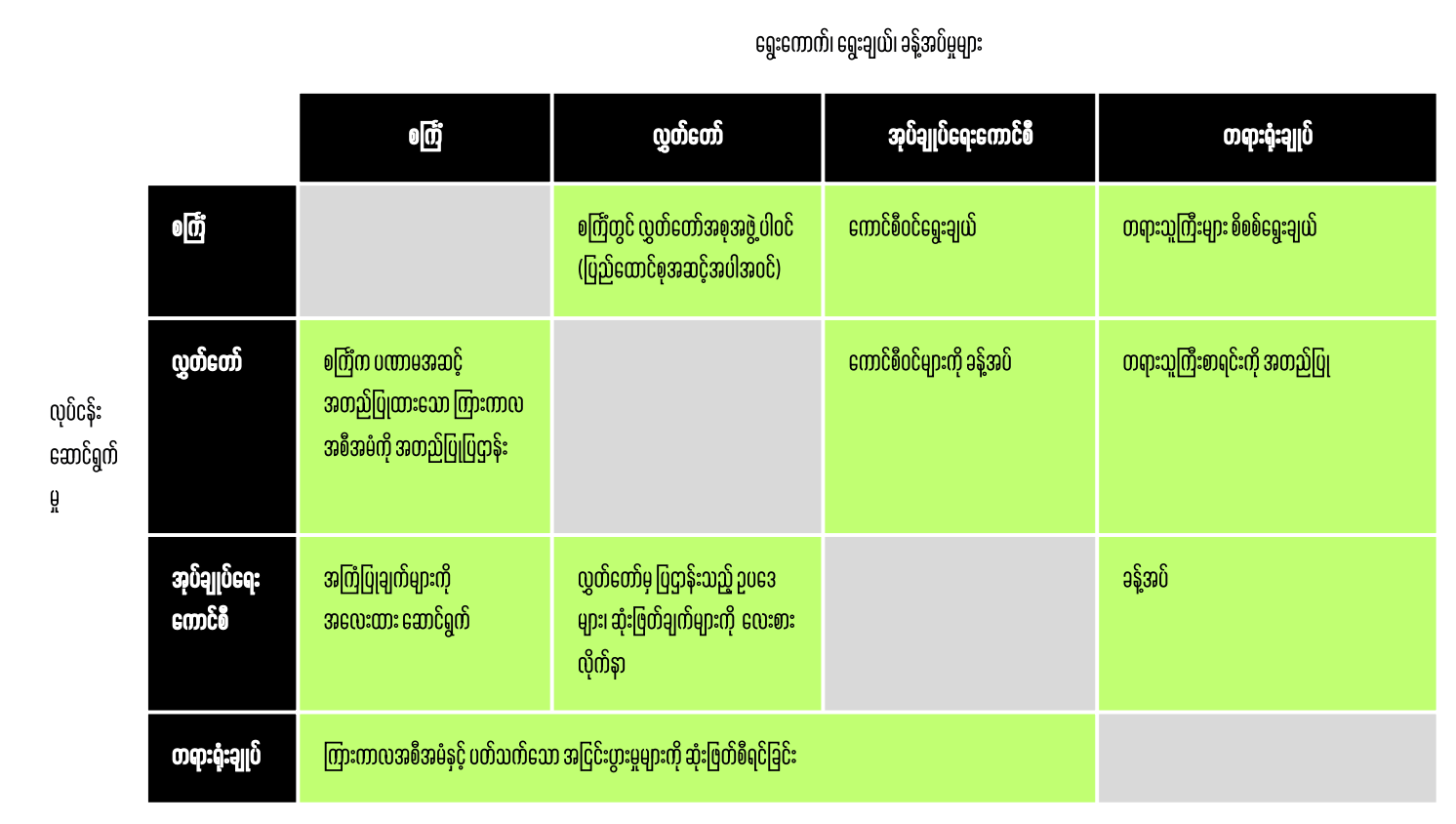
Cooperation
The tasks include coordination and cooperation with the federal level and other regions to fight dictatorship and build a federal democratic union, as well as coordination on tax collection.
The draft arrangement states that coordination, cooperation, mutual support and assistance will be carried out in sectors including administration, security, trade, transport and communications, rule of law, education, health, environmental conservation and humanitarian assistance.
No Military Sector
Although the working committee includes a group of officials from armed revolutionary local administration sectors, it is notable that the "Mandalay Region Interim Political Arrangement" (draft) includes only the executive, legislative and judicial sectors and contains no military provisions. On military matters, the "Mandalay Interim Governing Council" (MIGC) to be established under the draft will delegate full military management to the National Unity Government (NUG) and will only assist in strengthening it.
Although there are no military provisions, police work will exist under the MIGC for security in the Mandalay region.
Chapter 8, "Interim Judiciary", includes "Military Courts". This two-section provision states that military and civilian justice will be kept separate, that cases involving civilians must be tried only in civilian courts formed under the interim arrangement, and that no civilian may be tried by a military court.
The Transitional Period
During the interim period, the Mandalay Region Hluttaw will form the "Mandalay Region Transitional Arrangement Preparatory Commission" with representatives from the six groups in the original working committee.
Who Can Amend the Interim Arrangement, and How
The current "interim arrangement" draft written by the working committee is still being revised and supplemented after gathering suggestions. Although some have criticized it as politically reviving the former 14 regions and states model, it has emerged from the current needs of the revolutionary period and is a draft that will not be held rigidly.
Those wishing to amend the arrangement, whether Mandalay Region Hluttaw representatives, the MIGC, the Coordination Corridor or the people of the Mandalay region, may submit proposals to the Mandalay Region Hluttaw under the procedures.
If at least one-third of Hluttaw representatives agree, the draft amendment must be sent to the corridor. If at least 65 percent of representatives attending the corridor accept it, it must be preliminarily approved and sent to the Hluttaw. Once the Hluttaw approves the draft under its procedures, it must be sent to the MIGC chair, who must sign and announce the amendment to the public within seven days.
Adoption of the Draft Arrangement
The draft arrangement has been reviewed and revised at the working committee's meetings held from April 29 to May 23, 2025, and further reviews and revisions are ongoing.
According to working committee members, the draft is expected to be adopted this September.
Conclusion
Political developments based in the Mandalay region will soon be seen. Efforts to include public participation throughout the political process and cooperation among different forces can be said to be distinctive features of the Mandalay-based process. However, the draft due for adoption soon may still contain points for discussion and gaps in content. It is certainly a process worth discussing and following among the people of the Mandalay region and those interested in federal affairs.
Sources
1. Anti-junta Forces Coordination Committee - Mandalay
2. 20250526_MDY_ Interrim_ Political_ Arrangement_ Version_ II.pdf
Related updates
A House Built on Sand – The Junta's Election Plan
Gerrymandering means grouping or spreading out areas of assured support so that the outcome a party needs can be shaped as desired. For the junta, it has already created conditions in which only its backed Union Solidarity and Development Party (USDP) and a few supporting parties can contest and win, having dissolved major parties such as the National League for Democracy (NLD) and the Shan Nationalities League for Democracy (SNLD) amid a broad political boycott. In that situation, it needs to create the appearance that the election can be held widely.
Introducing the Arrangement for Transitional Constitution (AFTA)
As the Spring Revolution has championed "ending military dictatorship and building a federal democratic union", discussions on the constitution have been taking place since February 2021. Revolutionary forces have rejected and opposed the 2008 Constitution, controversially adopted under military dictatorship, and revolutionary organizations have declared it void. During the revolution, Parts 1 and 2 of the Federal Democracy Charter have been issued and used as a constitutional framework. The roadmap set out in the charter also includes, as one of its stages, drafting a constitution for the post-revolutionary transition period during the revolution itself.
ASEAN, the UN and International Engagement on Myanmar in October
October was a period when Myanmar's affairs were once again discussed on the world political stage, with the ASEAN Summit and the UN General Assembly. Below is a summary report of international developments on Myanmar during October.
NUG Deputy Minister of Human Rights Granted Leave from Duties
The NUG announced on March 7 that Khun Bedu Htan, one of the deputy ministers of the National Unity Government (NUG) Ministry of Human Rights, had been granted leave from his duties.